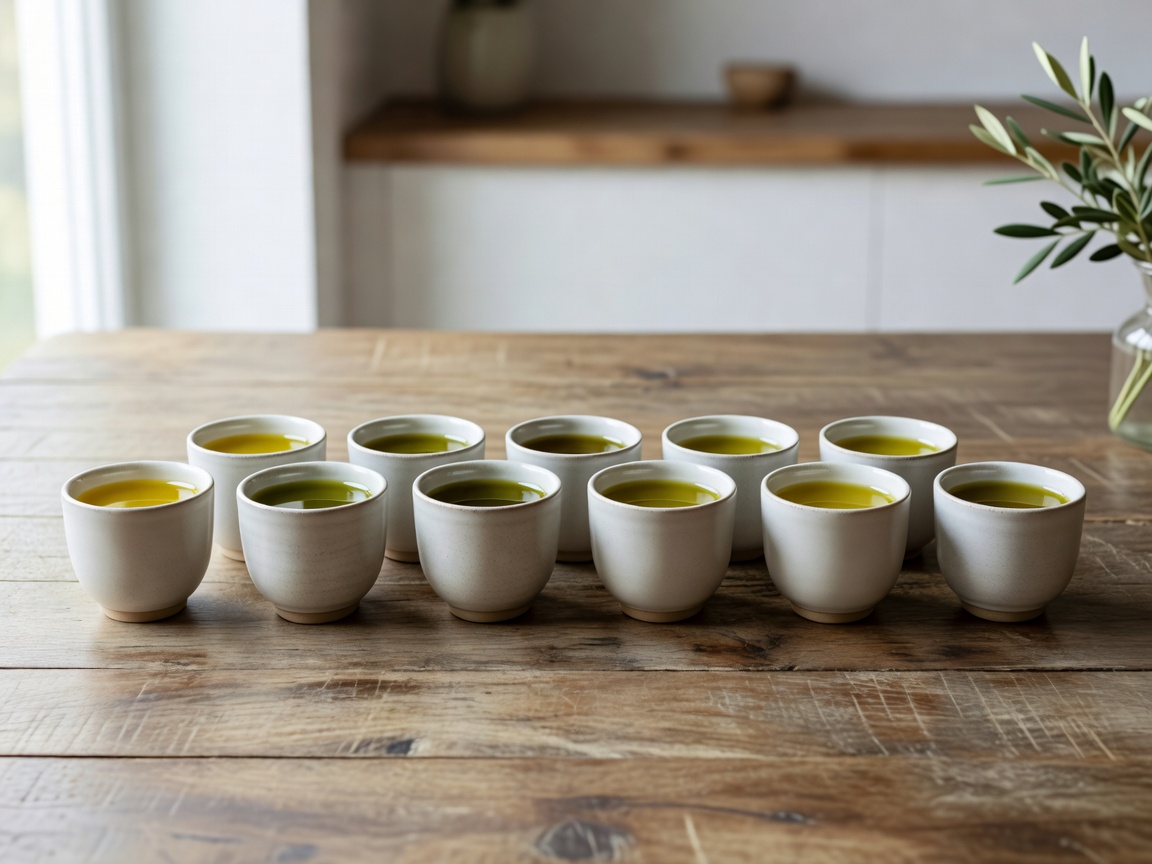
A simple tasting sequence
Professional tasting often uses dark or covered vessels so colour does not influence judgement. Warm the covered cup in your hand, smell the oil, then take a small sip. Draw in a little air if comfortable and notice how the flavour develops. Swallow or discard according to the room’s instructions, then pause before the next sample.
Begin with the mildest or lightest style and move toward more intense oils. Water and plain bread may be offered, but bread can add flavour and texture that affects comparison. Follow the host’s sequence when one is provided.
Four useful terms
- Fruitiness
- The fresh smell and taste associated with healthy olives. It can suggest green herb, leaf, grass, ripe fruit or other impressions.
- Bitterness
- A drying or bitter sensation on the tongue. It is not automatically a fault and may be part of a balanced oil.
- Pungency
- A peppery, warming sensation in the throat. It can arrive quickly or build after swallowing.
- Defect
- An unwanted sensory characteristic linked to poor fruit, handling or storage. Ask the trained host to explain the term rather than guessing.
Colour has limits
Green oil is not automatically fresher, stronger or better than golden oil. Colour can reflect fruit maturity, variety, processing and storage, but it is easily overvalued. Taste and aroma provide more useful evidence in a structured comparison.
Regional styles are not fixed rules
Coastal and inland regions may present different harvest timing, varieties and production choices. Early-picked oils can show a sharper green profile; later-picked oils may feel rounder and softer. These are broad tendencies, not guarantees. Climate, mill practice and storage change the final result.
At a tasting, ask what was compared: harvest stage, blend or single variety, filtration, storage age and serving temperature. Avoid turning one sample into a claim about an entire country or region.
Room etiquette and food pairing
Keep fragrance low. Avoid perfume before a tasting and allow others time to assess each sample. Take notes using your own words. “Fresh,” “leafy,” “peppery,” “bitter” and “soft” are more useful than trying to sound technical.
Food pairing is a practical extension, not a quality test. Mild oils may suit delicate vegetables or fish; assertive oils can stand up to beans, bitter greens or grilled foods. Allergies and dietary requirements should be stated before any food is served. No health outcome should be inferred from flavour or colour.
Use harvest seasons to understand timing and mill experiences to connect sensory results with production.